



Introdution:
Typhoid fever, known medically as enteric fever, is a serious systemic bacterial infection that occurs in most developing and endemic countries. Indeed it is not just a simple disease of the stomach or intestines, Moreover it is a serious infectious disease that affects the entire body.

Etiology/causes:
The main cause of typhoid fever is bacteria Salmonella typhi.

Fecal-Oral Route:
Specifically, typhoid only spreads through the fecal-oral route, such as through contaminated food or water. Its main sources are the following:
Contaminated food and water:
Using water that contains sewage water, or dirty drains, wells, and damaged pipelines can transmit the infection.
Street food.
Poor personal hygiene.
Not washing hands with soap for at least 20 seconds after defecation is the most common cause of disease transmission.
#Fresh vegetables
#Unripe fruits
#semi-cooked food
#unpasteurized milk
Pathophysiology:
The severity of typhoid fever depends on how well Salmonella Typhi can survive by deceiving the human body’s immune system.
Step 1: Survival Through Gastric Acid
When the bacteria enters the body through contaminated food or water, it is first exposed to powerful gastric acid.
If the patient is:
The gallbladder
Bacteria are quietly increasing in number.
Stage 5: secondary bacteremia.
When the number of bacteria in these organs becomes too high, they re-enter the bloodstream in large quantities.
Acid deficiency in the stomach (hypochlorhydria)
Using proton pump inhibitors (such as omeprazole) reduces the protective capacity of the stomach. As a result, even a small number of bacteria can cause disease.
Stage 2:
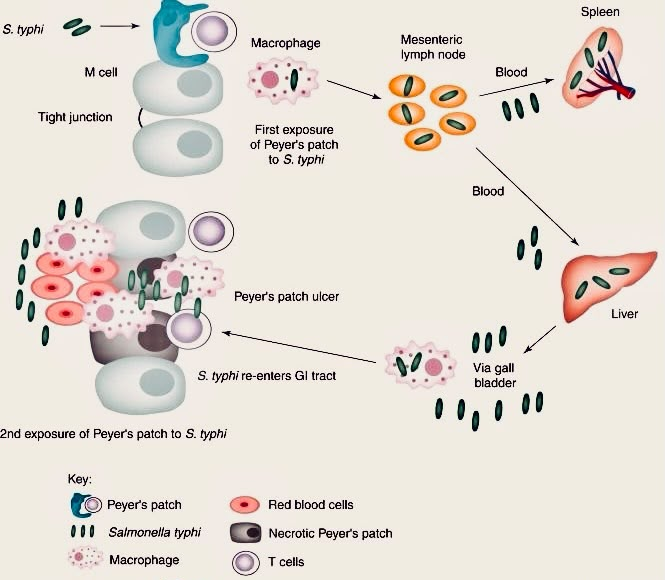
Consequently, the bacteria travels through the stomach to the distal ileum. The specific cells present here, called M cells (Microfold cells), become the target of bacteria. Bacteria attach to and enter these cells with the help of specific structures (Fimbriae) on their surface.
Step3:
After crossing the intestinal wall, the body’s defense cells (macrophages) absorb the bacteria within themselves in order to end it. But Salmonella Typhi has an extraordinary ability. It thwarts the destructive system (Phagosome-Lysosome Fusion) inside the macrophage with the help of its Vi Capsular Polysaccharide and other virulence factors.
Additionally, the body does not eliminate the bacteria. Rather, they survive within the macrophage, and that’s where the numbers start to grow. For this reason, medical experts call typhoid an intracellular infection.
Stage 4: Primary bacteremia:
Infected macrophages then pass through the lymph vessels to the mesenteric lymph nodes. Afterward, the thoracic duct passes them through the blood. Doctors refer to this stage as Primary Bacteremia. This bacteria then reaches various reticuloendothelial organs of the body, such as:
liver
Spleen
Bone marrow.
Incubation period:
It usually takes 7 to 14 days for symptoms to appear after being infected with Salmonella Typhi. However, this period can range anywhere from 5 to 30 days depending on the host’s immunity.
Signs and symptoms of typhoid fever:
Ladder fever
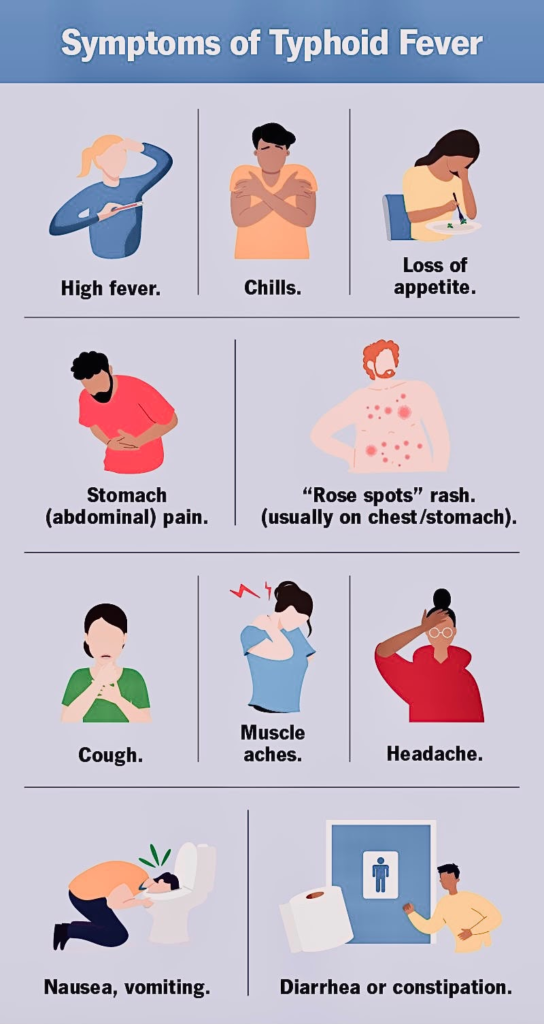
The most common symptom of typhoid fever is step-ladder fever.
Unlike other fevers (such as viral infections or malaria), the fever in typhoid is not suddenly very high but gradually increases daily.
Gastrointestinal Symptoms
At the beginning of the disease, the patient may have the following complaints:
Severe headache.
Severe weakness
Generalized arthralgia (pain in the whole body and joints)
complete loss of appetite (anorexia)
- Dry cough
Constipation often occurs in adult patients.
- in children.
Diarrhea is more common.
Rose Spots
In the second week, small spots of light pink color may appear on the skin in about 10-30% of patients.
Hepatosplenomegaly (enlargement of the liver and spleen)
In typhoid, the body’s immune system becomes severely activated, resulting in:
- The liver.
- Spleen
Both can be increased in size.
During the examination, the doctor can often feel the swelling and sensitivity of these organs.
Diagnosis of typhoid fever:
First week Blood Culture the most reliable (Gold Standard) test. The sensitivity is about 60-80% before the antibiotic is started.
The second week or PCR detects the antibodies (O and H), while PCR provides a more accurate and faster diagnosis by identifying the DNA of the bacteria.
In the third week stool culture, more bacteria are excreted through the stool, so this test also helps in identifying the chronic carrier.
4th week urine culture is used in late diagnosed or complicated case.
Supplementary laboratory tests:
# Complete blood count (CBC)
The following changes are commonly seen in CBC:
Lack of white blood cells (leukopenia)
an increase in relative lymphocytosis
Mild anemia (low blood pressure)
Thrombocytopenia, especially in severe disease.
#Liver function tests (LFTs)
Typhoid can also affect the liver, causing: ALT& AST Levels may be slightly higher than normal, which is a sign of mild liver inflammation.
#Abdominal ultrasound (abdominal ultrasound)
Ultrasound helps to diagnose the following:Hepatomegaly (enlargement of the liver)
splenomegaly (enlargement of the spleen)
inflammation of the gallbladder (cholecystitis)
Free fluid in the stomach.
Early detection of other complications.
Treatment of typhoid fever
Typhoid fever can only be effectively treated with appropriate antibiotics. Rest alone, excessive use of water or home remedies cannot eliminate Salmonella Typhi from the body.The choice of antibiotic is based on the following factors: Severity of the disease the patient’s age. local antibiotic resistance pattern. Results of the Culture and Sensitivity Report.
1. Oral therapy for uncomplicated patients:
If the patient’s condition is stable, does not vomit, and can take the medicine orally, an oral antibiotic may be given.
Azithromycin 500 mg once a day (first priority)
In children:
- 10 mg per kg of weight per day for 5 to 7 days.
- The clinical rationale
- Azithromycin reaches effective amounts in the intracellular space, where Salmonella Typhi is present. That is why it is considered the first priority in the treatment of uncomplicated typhoid.
Alternative antibiotics Ciprofloxacin 500 mg twice a day.
7 to 10 days. Ciprofloxacin should only be used if When Culture & Sensitivity proves that the bacterium is sensitive to this drug, because resistance to it has increased in many areas of the world.
2. Intravenous therapy for severe patients:
The following patients should be admitted to the hospital immediately:
Mental confusion.
The septic symptoms (sepsis)
Reduction in blood pressure
Frequent vomiting.
a severe weakness.
lack of dehydration.
Persistent high fever.
What is XDR Typhoid?
When Salmonella typhi develops resistance to the following drugs:
Ampicillin.
Chloramphenicol.
Co-trimoxazole.
Ciprofloxacin.
Ceftriaxone.
This is called Extensively Drug-Resistant (XDR) Typhoid.
Antibiotics are not effective in such patients.
Treament of XDR Typhoid :
Meropenem (carbapenem class) this is the most important medicine for the treatment of XDR Typhoid.
- In the elderly: 1 gram every 8 hours.
- In children’s: 20-40 mg every 8 hours. For 10 to 14 days .
Medical reasons
Meropenem is a powerful carbapenem antibiotic that is effective against XDR Salmonella Typhi. It is often combined with azithromycin in severe patients. To eliminate bacteria both inside the body and inside the cells.
- During the treatment, the patient is given the following instructions:
- Use more water and ORS.
Eat soft, light and easily digestible food. - Take a full rest.
- Do not stop the course of antibiotics in the middle, even if the fever is gone.
Do not take any other medicine without the doctor’s permission.
Complications of typhoid fever:
Severe mental confusion.
Drowsiness.
The Muttering Delirium
Loss of consciousness.
Complications of other organ systems , If the infection spreads throughout the body, the following complications may occur:
Acute Kidney Injury (AKI).
Myocarditis – inflammation of the heart muscle.
Hepatitis – inflammation of the liver.
Cholecystitis – inflammation of the bladder.
Pneumonia.
Localized abscesses – accumulation of papules in different parts of the body.
Sepsis / septicemia – a serious infection in the blood
Prevention of typhoid fever:
Typhoid is a treatable and preventable disease, provided appropriate precautions are taken.
1. Safe drinking water. Use boiling water.
Drink filtered water.
Use water purified with chlorine or other safe methods.
Avoid non-standard ice cubes.
2. The food safety Eat freshly cooked food.
Wash vegetables and salads well.
Wash and peel the fruit yourself.
Avoid unpasteurized milk and dairy products.
Avoid non-standard street food.
The Hand Hygiene Wash hands with soap and water for at least 20 seconds.
After using the toilet.
before preparing food.
before eating.
before feeding the children.
This habit protects against many infectious diseases, including typhoid.

Conclusion:
Typhoid fever is a serious bacterial disease that can initially affect the entire body, starting with a mild fever and gastrointestinal complaints.
If it’s timely:
The early diagnosis
Appropriate antibiotic therapy.
Proper clinical monitoring.
Most patients make a full recovery.
However, a delay in treatment can cause intestinal perforation, severe bleeding, brain complications, septic shock, and even death.
Therefore, in case of continuous high fever, severe weakness and other symptoms of typhoid
one should immediately consult a Dr.
FAQ:
Question; What is typhoid fever ?
Typhoid fever, known medically as enteric fever, is a serious systemic bacterial infection that occurs in most developing and endemic countries. It is not just a simple disease of the stomach or intestines, but a serious infectious disease that affects the entire body.
What causes of typhoid fever ?
The main cause of typhoid fever is the following bacteria Salmonella typhoid The Facal-Oral Route
Typhoid only spreads through the fecal-oral route, i.e. through contaminated food or water.Why is a single widal test not enough to make a final diagnosis of typhoid?
Answer: In Pakistan 90% clinical do Vidal test for typhoid fever ; The widal test measures the O and H antibodies produced in the body against Salmonella typhi. The test is not reliable because: Antibodies can persist for a long time after an old infection.
Antibodies can also be positive in vaccinated people. Antibodies may be elevated earlier even in healthy individuals living in epidemic areas. Therefore, for a better diagnosis of the Vidal test, it is necessary to see a four-fold increase in the amount of antibodies in two samples at an interval of 7 to 14 days. Nevertheless, blood culture in the first week of illness is still considered the gold standard for diagnosing typhoid.🔴 Important Medical Note & Disclaimer:
The health and medical information provided in this article is strictly for educational, informational, and awareness purposes. It should not, under any circumstances, be construed as professional medical advice, formal diagnosis, or a definitive treatment plan. Typhoid fever is a serious systemic infection, and self-medication or misuse of antibiotics can lead to serious health care complications. If you or someone around you is experiencing persistent high fever or any of the symptoms mentioned above, please do not delay. Immediately visit a qualified doctor or your nearest healthcare clinic for proper medical diagnosis and professional guidance
✍️ About The Author :
Dr. Sufiyan Awan (MD – Doctor of Medicine)
Dr. Sufiyan Awan is a dedicated medical professional and healthcare researcher with comprehensive clinical exposure. He has formerly served as a House Officer at Nishtar Hospital, Multan, where he managed diverse clinical cases. Along with his foundational medical expertise, Dr. Sufiyan has completed specialized training with the World Health Organization (WHO), enhancing his insight into global health standards and infectious disease management. He actively writes evidence-based medical articles to bridge the gap between complex clinical science and public health awareness, helping readers access reliable and scientifically accurate medical information.