


Dengue fever spreads through a single mosquito bite and that’s exactly why choosing the right mosquito repellent matters so much. There’s no vaccine widely available to most people and no specific cure once someone is infected. Prevention in other words is still the strongest tool available. Indeed, a good repellent is one of the simplest most affordable parts of that defense.
What Is a Mosquito Repellent for Dengue Fever?
A mosquito repellent is a product applied to skin or clothing that makes a person less attractive or less detectable to mosquitoes. It doesn’t kill mosquitoes the way an insecticide does. Instead, it interferes with the mosquito’s ability to sense body heat, sweat and carbon dioxide. These signals mosquitoes use to find a person to bite in the first place. For a repellent to be considered reliable health regulators typically require it to reduce the chance of a bite by at least half. (vs unprotected skin).
Mosquito Repellent and Dengue Fever Connection
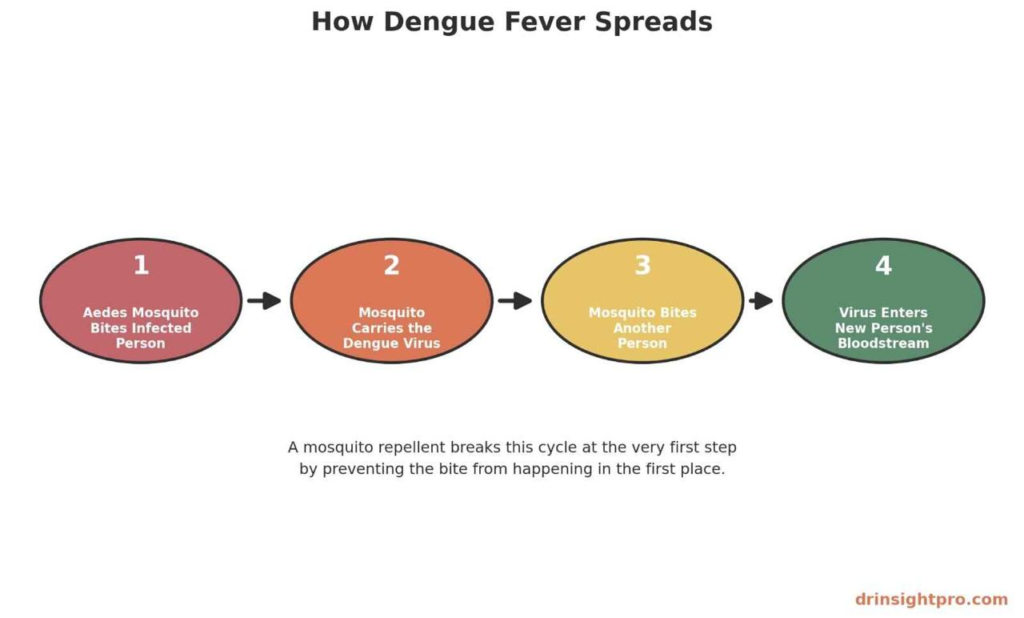
Dengue fever is a viral illness. However, the virus itself doesn’t spread from person to person through the air or casual contact. It needs a carrier and that carrier is a mosquito. When an infected mosquito bites someone, it passes the virus directly into the bloodstream. There is no other common route of transmission for most people.
Which Mosquito Spreads Dengue?
- Dengue is spreads mainly by the Aedes aegypti mosquito with Aedes albopictus also playing a role in some regions. These mosquitoes behave differently from the ones most people picture when they think of malaria or typical evening mosquito bites.
- Aedes mosquitoes are aggressive daytime biters. They’re most active in the early morning and late afternoon, though they can bite at any time, including indoors. They also breed in small amounts of stagnant water a bottle cap a flowerpot tray an old tire which means they often live found close to homes rather than out in open fields or wetlands.
Mosquito Repellent for Dengue Fever prevention Guide;
- Repellent doesn’t treat dengue and it doesn’t build immunity. What it does is break the chain of transmission at its earliest point the bite itself. If the mosquito never lands or leaves without biting the virus never has a chance to enter the body.
- This is particularly important in areas where dengue is common during outbreak periods or when traveling to a region with active transmission. Combined with other prevention steps, repellent meaningfully lowers personal risk even though no single measure offers complete protection on its own.
How to Choose the Right Mosquito Repellent for Dengue Fever
Health authorities including the CDC recommend choosing a repellent based on its active ingredient rather than its brand or scent. The following ingredients have demonstrated real effectiveness against Aedes mosquitoes in registered, tested products.
DEET
DEET serves for decades and remains one of the most thoroughly studied repellent ingredients available. It’s effective against Aedes mosquitoes and provides longer protection at higher concentrations generally ranging from around 7% up to 30%. Higher concentrations extend the protection window rather than making the product.
Picaridin
Picaridin performs comparably to DEET against mosquitoes and stands out for its lack of strong odor and non-greasy feel on skin. At a 20% concentration, it can provide protection lasting roughly 8 to 14 hours. This makes it a practical option for a full day outdoors.
Oil of Lemon Eucalyptus (OLE) and PMD
Oil of lemon eucalyptus and its synthesized form PMD is a plant derived option that has performed as well as DEET against mosquitoes in some studies. It’s important to distinguish this from pure lemon eucalyptus essential oil. It lacks testing for safety, making it a different product. Only EPA-registered OLE/PMD formulations carry proven protection. This ingredient suits poorly for children under three years old.

How to Use Mosquito Repellent the Right Way
Even an effective repellent works poorly if you apply it incorrectly. A few practical rules make a real difference;
Apply repellent to all exposed skin not just ankles or arms since Aedes mosquitoes will bite any uncovered area.
If using sunscreen as well apply sunscreen first and let it absorb then apply repellent on top.
Reapply according to the product label protection time depends on concentration, sweating and water exposure not a fixed number of hours for every product.
Using Mosquito Repellent for Dengue Fever on Adults
For most healthy adults, any EPA registered product containing DEET, picaridin, IR3535 or OLE/PMD remains safe when the label instructions you follow. Choosing a concentration depends mainly on how long protection is needed a short walk outside needs less than a full day at an outdoor event.
Mosquito Repellent for Dengue Fever on Children
Children need extra care, not necessarily different ingredients. Products suit poorly to infants younger than two months old physical barriers like mosquito netting over a stroller or crib work instead. For older children, an adult should apply the repellent rather than letting a child do it themselves spraying it onto the hands first and then applying it to the child’s face avoiding the eyes and mouth.
Using Repellent safe in Pregnancy
According to the CDC, EPA-registered repellents containing DEET, picaridin, IR3535 or OLE/PMD remain safe for use during pregnancy and while breastfeeding when used as directed. Since dengue infection during pregnancy can carry added risks avoiding mosquito bites in the first place is especially important and repellent use helps greatly rather than avoided in areas where dengue is present.

Contraindication of Mosquito Repellent
A number of everyday habits quietly reduce how well repellent actually works; Using unregistered natural oils. Many essential oils people sell as insect repellents lack proper testing for effectiveness and don’t provide reliable protection against dengue carrying mosquitoes.
Applying it under clothing Repellent needs to sit on exposed skin or on the outer surface of clothing to work; putting it underneath fabric wastes the product.
Skipping reapplication after swimming or heavy sweating Water and sweat wash off active ingredients faster than the label’s stated duration.
Combining repellent and sunscreen into one product Sunscreen typically needs reapplying more often than repellent and combination products make it hard to reapply one without overusing the other.
Relying on repellent alone Even a well applied repellent isn’t 100% effective so it works best alongside other prevention steps.
Prevent Mosquito Bites
Repellent is one layer of protection not the only one. A few additional habits lower risk further;
- Wearing long sleeves and long pants, particularly during early morning and late afternoon hours when Aedes mosquitoes are most active.
- Using screens on windows and doors, and mosquito nets where screening isn’t available.
- Treating clothing and gear with permethrin a separate product designed for fabric rather than skin.
- Removing standing water around the home even small amounts in containers, plant saucers or discarded items can become breeding sites
FAQs
Can mosquito repellent fully prevent dengue fever?
No single measure guarantees complete protection. Repellent significantly reduces the chance of a bite, but combining it with protective clothing, mosquito nets, and reducing breeding sites offers stronger overall prevention.
Which mosquito repellent works best against dengue-carrying mosquitoes?
Products containing DEET, picaridin, IR3535 or oil of lemon eucalyptus (OLE/PMD) have all demonstrated effectiveness against Aedes mosquitoes when used as EPA-registered formulations applied according to label directions.
Is mosquito repellent safe for babies?
Repellent suits poorly for infants under two months old. Physical protection like mosquito netting works instead for very young babies.
Can pregnant women use mosquito repellent safely?
Yes, EPA-registered repellents with DEET, picaridin, IR3535 or OLE/PMD remain safe during pregnancy when you use them as directed and avoiding mosquito bites is generally encouraged in dengue risk areas.
About the Author
Dr. Sufiyan Awan is a licensed medical doctor who completed his internship (house job) at Nishtar Hospital, Multan. He holds professional certifications from the World Health Organization (WHO), combining clinical training with updated global medical standards. Dr. Sufiyan is dedicated to sharing clear, evidence-based health guidance to help readers make safe and informed wellness decisions.
Medical Disclaimer
The medical content provided on DrInsightPro is created solely for educational and public health awareness purposes. It does not replace professional medical advice, clinical diagnosis, or personalized treatment plans. Always consult a qualified physician regarding any medical conditions or health concerns. Never delay or disregard expert medical guidance based on information read on this website.