


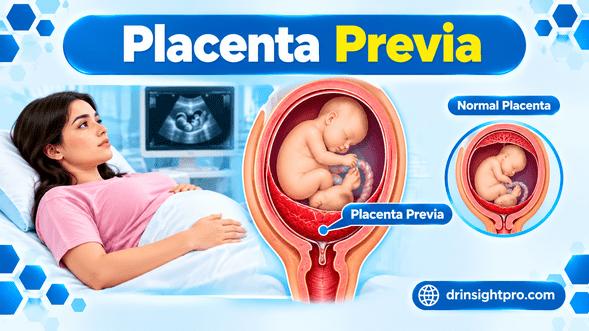
Bleeding during pregnancy can feel scary. In fact, it does not always mean something terrible is happening. For example, sometimes the cause is placenta previa (a low placenta that covers the mouth of the womb). Fortunately, many women with this condition have healthy babies. Overall, early checkups and good care make the biggest difference.
What Is Placenta Previa?
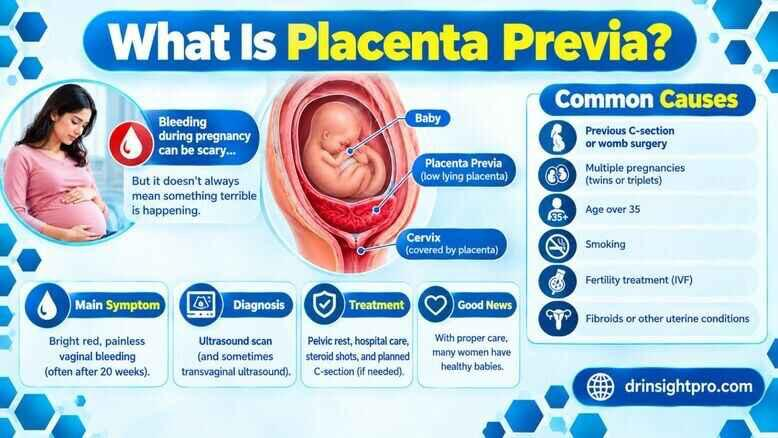
The placenta is a soft organ that grows inside your womb (uterus). Additionally, it brings food and oxygen to your baby through the umbilical cord. Typically, in most pregnancies, the placenta sits at the top or side of the womb. However, in placenta previa, the placenta sits low instead. Specifically, it covers part or all of the cervix. Because the cervix is the narrow mouth of the womb, therefore it opens during labor so the baby can come out.
Types of Placenta Previa
Doctors group this condition by how much of the cervix the placenta covers.
Complete (full) placenta previa: The placenta covers the whole opening of the cervix.
Partial placenta previa: The placenta covers only a part of the opening.
Marginal placenta previa: The edge of the placenta touches the cervix but does not cover it.
Low lying placenta: The placenta sits close to the cervix but does not reach it.
Full placenta previa carries the highest risk. On the other hand, a low lying placenta often moves away from the cervix by itself.
Placenta Previa Symptoms
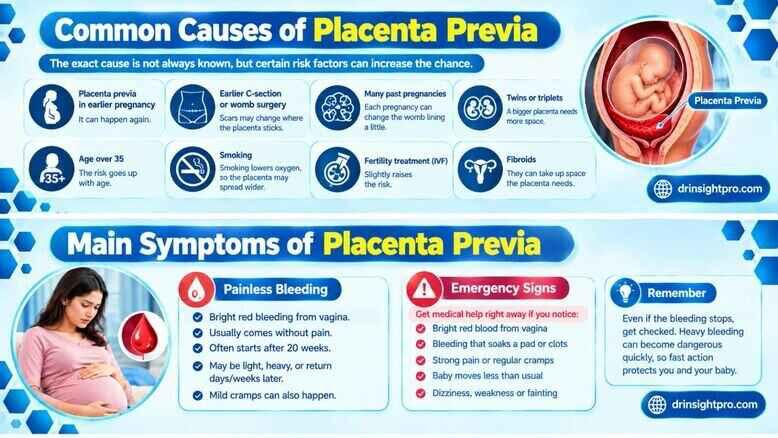
The main sign is bright red bleeding from the vagina. It usually comes without pain, and it usually starts after the 20th week of pregnancy.
Painless Bleeding
The Most Common Symptom bleeding may be light or heavy. It may stop on its own and then return days or weeks later. Some women also feel mild cramps (tightening of the womb). Still, bleeding without pain is the classic sign.
Emergency Sign
Never ignore bleeding in pregnancy. Call your doctor or go to the hospital right away if you notice any of these signs:
- Bright red blood from the vagina
- Bleeding that soaks a pad or comes with clots
- Strong pain or regular cramps
- Your baby moves less than usual
- Dizziness, weakness, or fainting
- Heavy bleeding can quickly become dangerous. Fast action protects both you and your baby.
What Causes Placenta Previa? Common Risk Factors
Doctors do not know the exact cause. However, some things raise your chance. A risk factor does not mean you will get the condition.
Placenta previa in an earlier pregnancy: It can happen again.
Previous C-sections or womb surgeries cause scars inside the womb. These scars can change where the placenta attaches.
Many past pregnancies: Each pregnancy can change the womb lining a little.
Twins or triplets: A bigger placenta needs more space.
Age over 35: The risk goes up with age.
Smoking: Smoking lowers oxygen, so the placenta may spread wider.
Fertility treatments like IVF slightly raise the risk. IVF involves joining the egg with sperm outside the body.
Fibroids (small lumps in the womb): They can take up space the placenta needs.
Therefore, if you have any of these risks, tell your doctor early. Your care team can then watch your pregnancy more closely.
Placenta Previa Diagnosis: Ultrasound Scan and Test
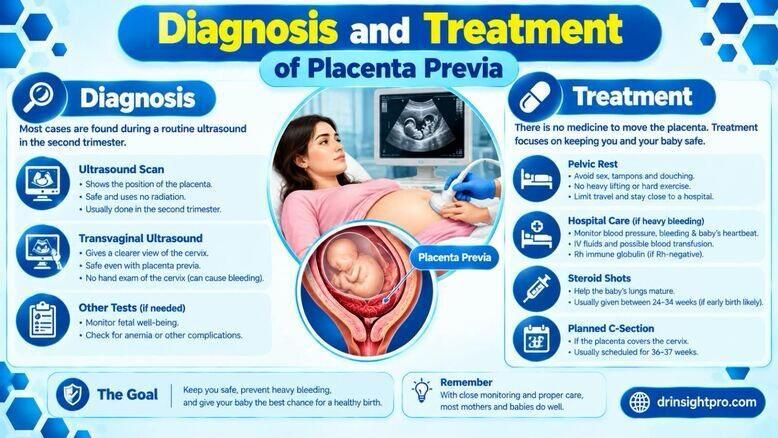
Most cases are found during a routine ultrasound in the second trimester, which means the middle three months.. An ultrasound uses sound waves to make a picture of your baby and placenta. It uses no radiation, so it is safe.
If your placenta looks low, your doctor may suggest a transvaginal ultrasound. In this scan, a thin, smooth tool goes a short way into the vagina. It gives a clearer picture of the cervix. Doctors use it to confirm where the placenta sits. Research shows this scan is safe, even with placenta previa. However, your doctor will not do a hand exam of the cervix. That kind of exam can cause heavy bleeding.
Placenta Previa Complications for Mother and Baby
Placenta previa can cause problems for both of you. Fortunately, good care lowers most of these risks.
Risks for the Mother
Heavy bleeding: This is the biggest danger, mainly during labor and delivery.
Blood transfusion: Some women need donor blood after heavy bleeding.
Placenta accreta: Here, the placenta grows too deep into the womb wall. It can cause serious bleeding after birth.
Hysterectomy (surgery to remove the womb): This is rare. Doctors do it only when nothing else stops the bleeding.
Risks for the Baby
Early birth: Doctors may deliver the baby early to protect the mother.
Low birth weight: Babies born early are often smaller.
Less oxygen: Heavy bleeding can reduce the oxygen your baby gets.
Breathing trouble: Early babies have small, weak lungs.
This list sounds scary. Still, remember one thing. With close care, most mothers and babies do well.
Placenta Previa Treatment
No medicine can move the placenta. Instead, doctors keep you and your baby safe until your baby is ready to be born. The plan depends on how much you bleed, how many weeks pregnant you are, and the type of previa.
Pelvic Rest; What to Avoid
Doctors often advise pelvic rest. This means you avoid anything that can bother the cervix. Specifically, you should;
- Avoid sex.
- Avoid tampons and douching (washing inside the vagina).
- Avoid heavy lifting and hard exercise.
- Your doctor may also ask you to limit travel. In addition, stay close to a hospital.
Hospital Care for Heavy Bleeding
If you bleed a lot, you will stay in the hospital. Nurses will check your blood pressure, your bleeding, and your baby’s heartbeat. You may get fluids through a vein (an IV drip). Some women also need a blood transfusion. If your blood type is Rh-negative, you may get a shot called Rh immune globulin. It protects your future pregnancies from a blood-match problem.
Steroid Shots to Help the Baby’s Lungs
If early birth looks likely, doctors often give steroid shots. These medicines help your baby’s lungs grow faster. Doctors usually give them between weeks 24 and 34. As a result, your baby can breathe better after birth.
Planned C-Section for Placenta Previa
If the placenta covers the cervix, a normal vaginal birth is not safe. The placenta blocks the way out. So you will need a C-section (an operation to take the baby out through the belly). Doctors usually plan this surgery for weeks 36 to 37.
How to Lower Your Risk of Placenta Previa
You cannot fully prevent placenta previa. Still, a few steps can help;
Do not smoke. If you smoke, ask your doctor for assistance in quitting.
Space your pregnancies. Allow your body time to recover between births.
Avoid a C-section unless necessary. Discuss the benefits and risks with your doctor.
Attend every prenatal visit. Regular checkups help identify problems early.
Living With Placenta Previa: Safety Tips at Home
Receiving this diagnosis can be stressful. These simple steps can help you stay calm and safe:
Learn your warning signs. Know when to contact your doctor.
Pack a hospital bag early. Keep it ready a few weeks before your due date.
Ask for help. Let family or friends assist with household chores and caring for other children.
Plan your Transportation Know how to reach the hospital quickly.
Eat well and drink water. Iron-rich foods help your body handle blood loss.
FAQs
Yes, placenta previa is a serious condition. It can lead to heavy bleeding and early birth. Early babies may face breathing trouble or low birth weight. Fortunately, close medical checkups, hospital care, and a planned C-section lower these risks so that many babies are born healthy
Placenta previa is a pregnancy problem where the placenta sits low in the womb. It covers part or all of the cervix. This can cause painless and bright red bleeding in the later months of pregnancy. Doctors usually find it during a routine ultrasound sca
The main sign of placenta previa is sudden vaginal bleeding. The blood is bright red. This bleeding usually happens without any pain. It often starts after the 20th week of pregnancy. The bleeding may stop and then return days later. Call your doctor or go to the hospital right away if you see any bleeding.
Yes, placenta previa can go away on its own during pregnancy. As the womb grows and stretches upward, the placenta often moves away from the cervix. This happens more often with a low lying placenta than with full placenta previa. Your doctor will repeat the ultrasound later to check the new position.
No, a normal delivery is not safe when the placenta still covers the cervix. In that case you will need a C-section (an operation to take the baby out through the belly). However, if the placenta moves away before labor, a vaginal birth may become possible. Your doctor will decide after your latest scan.
References
- Mayo Clinic. “Placenta previa: Symptoms and causes.” https://www.mayoclinic.org/diseases-conditions/placenta-previa/symptoms-causes/syc-20352768
- StatPearls Publishing. “Placenta Previa.” NCBI Bookshelf. https://www.statpearls.com/point-of-care/27262
- Merck Manual Professional Version. “Placenta Previa.” https://www.merckmanuals.com/professional/gynecology-and-obstetrics/abnormalities-of-pregnancy/placenta-previa
Medical Disclaimer
This article is for general educational purposes only. It does not replace individualized medical advice. If you experience vaginal bleeding during pregnancy, contact your doctor right away. Always follow your obstetrician’s guidance for diagnosis and delivery planning
About the Author
Dr. Sufiyan Awan is a medical doctor and former House Officer at Nishtar Hospital, Multan. He has completed professional healthcare certifications from the World Health Organization. He founded drinsightpro.com to share accurate, research-backed medical insights.