


CT vs MRI is a common question when doctors need detailed images of the inside of the body. Although both tests create detailed images, they use different technologies and are better suited to different medical problems
What Is a CT Scan?
A CT scan takes many X-ray pictures from different angles as you lie still. A computer then combines these pictures into detailed cross sections of your body. Think of slicing a loaf of bread. Each slice shows what is inside at that exact level.
The machine looks like a large donut. You lie on a table that slides through the opening. The scan itself takes only a few minutes. As a result, doctors rely on CT when time matters.
What Is an MRI?
An MRI uses a powerful magnet and radio waves. It does not use X rays. However, the magnet makes the tiny water particles in your body line up. Radio waves then knock them out of line for a moment. When they return to position they send out signals. A computer turns those signals into very sharp pictures.
The MRI machine is a long tube. It makes loud thumping and buzzing noises. Most centers give you earplugs or headphones. Furthermore, you must stay very still for the whole scan because movement blurs the pictures.
| Feature | CT Scan | MRI |
|---|---|---|
| Full name | Computed tomography | Magnetic resonance imaging |
| Main technology | X rays and a computer | Strong magnet and radio waves |
| Radiation | Yes (low to moderate dose) | No |
| Scan time | About 5 to 15 minutes | About 20 to 60 minutes |
| Best for | Bones, lungs, emergencies, bleeding | Brain, spine, joints, soft tissue |
| Noise level | Quiet | Loud knocking sounds |
| Cost | Usually lower | Usually higher |
| Metal implants | Mostly safe | Needs careful screening |
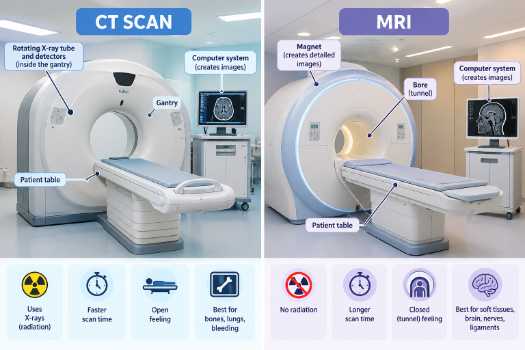
CT vs MRI: When Doctors Choose Each Scan
| CT Scan | MRI |
|---|---|
| Emergency injuries: Preferred when doctors need fast images after accidents, falls, or major trauma. | Brain and nerve problems: Provides detailed images of the brain, spinal cord, and nerves. |
| Brain bleeding: Quickly detects acute bleeding inside the skull, especially after a head injury. | Back problems: Shows spinal discs, nerves, and nerve compression in detail. |
| Bones and fractures: Excellent for complex fractures and small fracture lines. | Joint injuries: Shows ligaments, tendons, cartilage, and other soft tissues clearly. |
| Lung and chest problems: Provides detailed images of the lungs and can detect conditions such as pneumonia and pulmonary embolism. | Children and younger patients: Avoids ionizing radiation, which can be useful when repeated imaging is needed. |
| Sudden abdominal pain: Helps detect appendicitis, bowel obstruction, perforation, and other acute abdominal problems. | Liver and bile ducts: Provides detailed images of liver lesions and bile ducts, including MRCP when appropriate. |
| Kidney stones: Quickly detects and locates many urinary stones. | Pelvic organs: Provides detailed images of organs such as the uterus, ovaries, and prostate. |
| Cancer staging: Helps assess the spread of many cancers, particularly in the chest and abdomen. | Neurological conditions: Particularly useful for conditions such as multiple sclerosis and certain types of stroke. |
| Some patients with implants: MRI may not be suitable for some older or non-MRI-compatible pacemakers and other devices. | No ionizing radiation: Useful when a condition requires repeated imaging and MRI is clinically appropriate. |
![MRI showing Giant Cell Tumor [GCT]](https://drinsightpro.com/wp-content/uploads/2026/09/ChatGPT-Image-Sep-22-2026-08_49_39-PM-1.jpg)
CT V/S MRI: Which Test Is More Accurate?
Accuracy depends on the question your doctor is asking. CT is more accurate for bone and lung problems and for bleeding. However, MRI is more accurate for the brain and spine and for joints and many soft tissue conditions. In other words, each test is the best tool for a different job.
Safety: What You Should Know
Radiation From CT
A CT scan gives a higher radiation dose than a regular X ray. The dose from one scan is small and the risk of harm for any single test is low. However, radiation adds up over a lifetime. Doctors follow a simple rule. They order the test only when the benefit clearly outweighs the risk. Ask your doctor whether a scan is truly needed if you have had many scans before.
Contrast Dye
Both tests sometimes use contrast dye to make organs stand out. The dyes are different.
- CT contrast contains iodine. It can cause allergic reactions in some people. It can also stress the kidneys in patients with kidney disease.
- MRI contrast contains a metal called gadolinium. It is safe for most people. However, doctors use extra caution in patients with severe kidney disease.
Tell your doctor about any past allergy to contrast dye. Also mention any kidney problem.
MRI and Metal
The MRI magnet is extremely strong. It can pull on metal objects. Therefore, staff will ask you about these items:
- Pacemakers and defibrillators
- Brain aneurysm clips
- Cochlear implants
- Metal fragments in the eye
- Some joint replacements and insulin pumps
Most modern implants are safe. However, you must always tell the technician before the scan.
Pregnancy
Doctors avoid CT in pregnancy unless the situation is urgent. MRI without contrast is usually the safer choice for both mother and baby. Always tell your doctor if you are or might be pregnant.
CT vs MRI: What Does the Experience Feel Like?
During a CT scan you lie on a table and stay still. The machine hums as the ring spins around you. If you receive contrast dye you may feel warmth and a metallic taste for a few seconds. The test itself is painless.
During an MRI you lie inside a narrow tube. The machine makes loud knocking sounds. You get earplugs or headphones. The scan can last up to an hour for some body parts. Consequently, patients who feel anxious in tight spaces should tell the doctor early. Some centers offer mild sedation or open MRI machines.
CT vs MRI: How to Prepare for Each Scan
| Step | CT Scan | MRI |
|---|---|---|
| Eating and drinking | May need to fast for 4 to 6 hours if contrast is used | Often no fasting unless the belly is scanned |
| Clothing | Wear loose clothes without metal | Wear loose clothes and remove all metal |
| Jewelry | Remove near the scan area | Remove all jewelry and hair pins |
| Medical devices | Report any device | Report every implant and device |
| Kidney check | Blood test may be needed for contrast | Blood test may be needed for contrast |
Meanwhile, always follow the instructions from your imaging center. However, every hospital has its own rules.
CT vs MRI: How Much Do They Cost?
Prices vary by country and hospital. In general, a CT scan costs less than an MRI. However, insurance coverage and local rules also play a major role. Ask the imaging center for a price estimate before your appointment. Furthermore, check whether your insurance needs prior approval.
CT vs MRI: Common Myths
Myth 1: MRI is always better than CT.
Not true. CT is better for emergencies and for bones and lungs.
Myth 2: CT radiation is dangerous every time.
A single scan carries a small risk. Doctors weigh this risk against the benefit each time.
Myth 3: MRI is completely risk-free.
MRI has no radiation. However, strong magnets and contrast dye still need careful safety checks.
Myth 4: You can pick the test yourself.
Your doctor chooses based on your symptoms and history. A wrong test can waste time and money. It can also miss the problem.
Questions to Ask Your Doctor
- Why do I need this scan?
- Is CT or MRI better for my condition?
- Will I need contrast dye?
- Is there a lower radiation option?
- How long will the scan take?
- When will I get my results?
When to Seek Medical Care Quickly
Do not wait for a scan appointment if you have any of these signs. Go to the emergency room right away.
- Sudden severe headache
- Weakness on one side of the body
- Severe chest pain
- Severe belly pain with fever or vomiting
- Heavy bleeding after an injury
Frequently Asked Questions
No, The scan is painless. The main discomfort comes from lying still and the loud noise.
A radiologist usually reviews the images within a day or two. Urgent cases get results much sooner.
MRI is usually better because it shows discs and nerves clearly. However, CT may help when bone detail matters.
Yes, Doctors sometimes order both when one test does not give enough information.
About Author
Dr. Hafsa Hadi is a consultant in gastroenterology and clinical medical writer. She leads content at drinsightpro.com, where she creates evidence-based resources to simplify intricate diagnostic and clinical management topics for patients and medical practitioners alike.
References
National Institute of Biomedical Imaging and Bioengineering (NIH) — Computed Tomography
https://www.nibib.nih.gov/science-education/science-topics/computed-tomography-ctNational Institute of Biomedical Imaging and Bioengineering (NIH) — Magnetic Resonance Imaging Fact Sheet
https://www.nibib.nih.gov/sites/default/files/2022-05/Fact-Sheet-Magnetic-Resonance-Imaging-MRI.pdfAmerican College of Radiology — ACR Appropriateness Criteria (the national evidence based guidelines that determine when CT, MRI or ultrasound is preferred for a given abdominal or chest condition)
https://www.acr.org/Clinical-Resources/ACR-Appropriateness-Criteria Cartwright SL, Knudson MP. Diagnostic Imaging of Acute Abdominal Pain in Adults. American Family Physician. 2015;91(7):452-459. Summarizes ACR guidance by pain location, with a table of imaging recommendations for appendicitis, diverticulitis, pancreatitis and other diagnoses.
https://www.aafp.org/pubs/afp/issues/2015/0401/p452.html